
4 min read
Are Paid Programming Courses Worth It?
We hire developers and read a lot of CVs. Here's what paid coding courses actually sell, why nobody looks at the certificate, and what we'd do with the same three months instead.
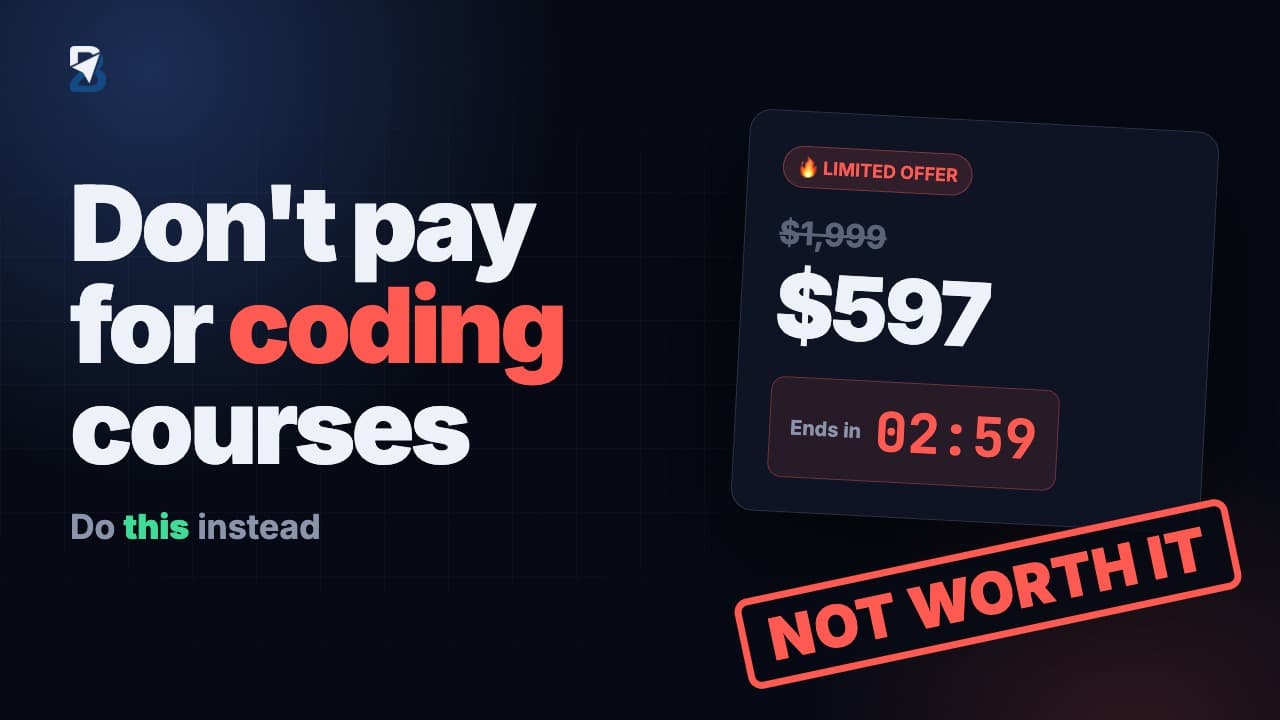
Open almost any programming course landing page and you'll see the same thing. Seventy percent off. The offer ends in three minutes. Refresh the page and the timer starts over. Come back tomorrow and it's still three minutes.
We hire developers, we review their code, and every few months we go through a pile of CVs. A lot of them list two or three paid courses. Far fewer have a link to anything the person actually finished. That gap is what this post is about.
What the money actually buys
A typical paid course is a few hundred short videos, some quizzes and a certificate at the end. A full bootcamp can cost about as much as a used car.
Now look at what's in those videos. Variables, loops, functions, a to-do app, a weather app, maybe a small shop with a fake cart. Almost all of it is available for free, and often written better:
The official documentation for React, Python, Node and pretty much every serious tool is free, and it's what working developers actually read.
MDN covers HTML, CSS and JavaScript in more depth than most courses ever will.
Harvard puts its whole intro course, CS50, online for nothing. Lectures, problem sets, all of it.
So you're rarely paying for information. You're paying for something else.
The green checkmark problem
What a course sells really well is the feeling of progress. Lesson 47, done. Green checkmark. Progress bar at 62%. It feels great, and we're not going to pretend it doesn't.
The trouble is that it isn't the same thing as being able to build something on your own. In a course, the teacher already knows the answer. The project works on the first try because they rehearsed it before they hit record. You follow along, it compiles, you move on.
Your first real task won't look like that. It'll be someone else's code, three years old, with a comment at the top that says do not touch this. And your ticket is to touch it. Nobody tells you which file to open. Figuring that out, without a video to pause, is most of the job. It's also exactly the part a course skips, because it's slow and messy and doesn't make good video.
About that certificate
When we hire, we don't look at it. Honestly, we've never met a team lead who does.
We ask two things. Can you show us something you built? And can you explain why you built it that way? Why this database and not another one. Why you split the code like this. What you'd change now. Someone who has struggled through a real project can talk about it for twenty minutes. Someone who only followed lessons usually runs out of things to say after two.
A link to a messy project you actually finished is worth more than a PDF with a gold border.
To be fair to courses
They aren't useless. Some people genuinely need someone else to set a schedule, or they just won't sit down and do it. And a good mentor who actually reads your code and tells you what's wrong with it is worth real money.
Just be honest with yourself about what you're buying. It's structure, and sometimes feedback. It's not a career in twelve weeks, whatever the landing page says.
What we'd do with the same three months
Pick one small thing you actually need. Not another to-do app. Something with a real reason to exist: a budget tracker because you have no idea where your salary goes, a page for a friend's bakery with the menu and a map, a Telegram bot that tells you when your bus is late. When you actually need the thing, you finish it.
Build it badly. Seriously. The first version should be ugly and half broken. Get stuck. Read the docs. Paste the error into a search box. Try again. That loop, getting stuck and getting yourself unstuck, is where the learning happens. It's also the one skill every job needs.
Put it online and show it to someone. Find a developer who'll be honest with you, a friend, a colleague, someone in a local community, and ask them to look at the code. One real code review teaches you more than a week of videos, because it's about your mistakes, not the ones the teacher planned.
Then build the next thing, a little bigger. Add a login. Add a database. Let five real people use it and see what breaks.
Free tutorials are fine for the first steps. Use them to learn the syntax, then stop watching as soon as you can build without them. And if you're going to pay for anything at all, pay for feedback, not for videos.
If you've built something and want a second pair of eyes on it, send it our way. We like looking at real projects, even messy ones. Especially messy ones.