
2 min read
The Magic of AI in Gaming: How NVIDIA DLSS Revolutionized Graphics with Frame Generation
From blurry upscaling to smart generation of entire frames. We break down how NVIDIA Tensor Cores work and why DLSS 3 became the defining graphics technology of the decade.
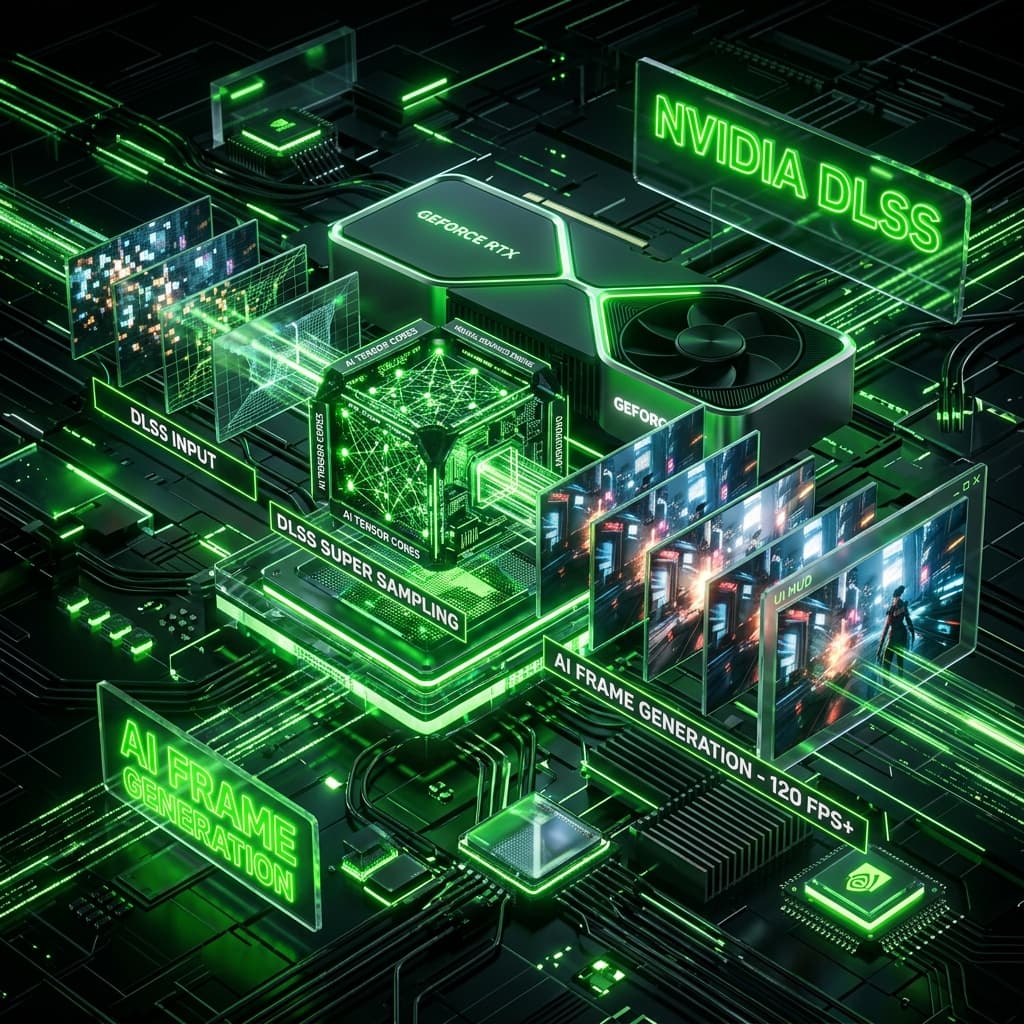
Where It All Began: DLSS 1.0 and the First Attempts
When NVIDIA first introduced Deep Learning Super Sampling (DLSS) alongside the RTX 20 series graphics cards, the technology looked like a rough experiment. The idea was bold: render the game at a low resolution (for example, 1080p) and then let artificial intelligence fill in the pixels up to 4K.
The first version was clumsy. The image often came out blurry, artifacts were hard to miss, and developers had to train NVIDIA's neural network for each individual game. But it was only the first step.
The Turning Point: DLSS 2.0 and Tensor Cores
DLSS 2.0 changed everything. NVIDIA dropped per-game training and built a single universal neural network. Tensor Cores came into play: specialized hardware units inside the GPU designed exclusively for AI matrix math.
The result was stunning: games could run twice as fast, and in places the picture looked even better and sharper than at native resolution. The algorithm learned to use temporal data (motion vectors from previous frames) to predict what the current frame should look like.
"We stopped simply drawing pixels. We made artificial intelligence guess them with mathematical precision." — NVIDIA engineers.
The Era of DLSS 3 and Frame Generation
With the Ada Lovelace architecture (the RTX 40 series), NVIDIA introduced something truly fantastic: AI Frame Generation. Where AI used to fill in only missing pixels, it now started generating entire missing frames!
How does it work under the hood?
- Optical Flow Accelerator (OFA): a dedicated unit analyzes two consecutive frames (frame 1 and frame 2).
- It calculates the direction and speed of every pixel's movement (building an optical flow map).
- The neural network combines this data with data from the game engine (geometry motion vectors).
- The AI literally renders an intermediate frame (frame 1.5) that never existed in the game engine!
This means the graphics card can output 120 FPS while the CPU processes only 60. A weak CPU is no longer the bottleneck that decides everything.
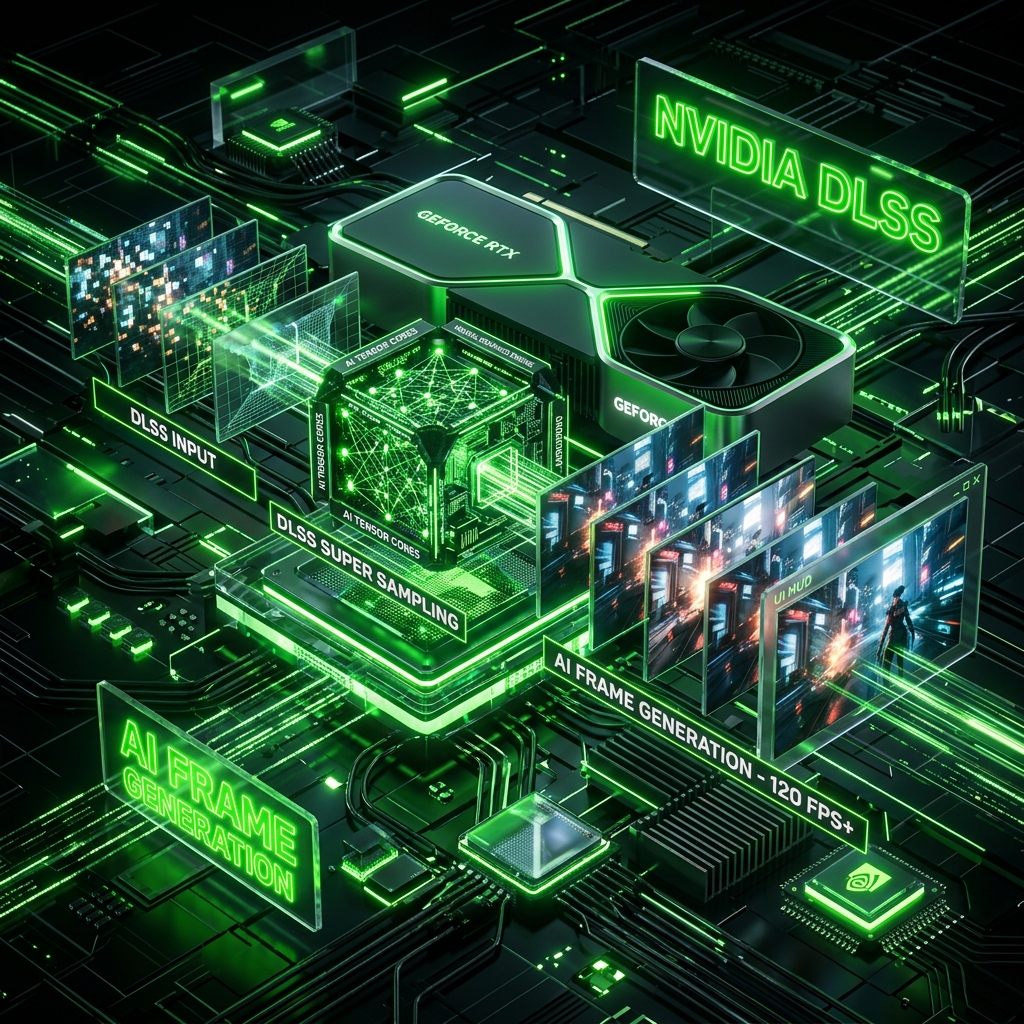
The architecture of tensor computing and optical flow generation.
The Future: Neural Rendering (DLSS 3.5 and Ray Reconstruction)
NVIDIA didn't stop at frame generation. DLSS 3.5 introduced Ray Reconstruction: AI now replaces the classic denoisers used in ray tracing. The neural network itself decides how light and reflections should fall, making the lighting crystal clear.
The future of computer graphics no longer depends solely on the raw computing power of transistors. It belongs to smart algorithms and artificial intelligence that "hallucinates" incredibly beautiful and realistic worlds in real time.