
4 min read
How Much Does It Cost to Build a Mobile App? What Drives the Price
What determines the cost of mobile app development: platforms, features, design, backend, integrations and support. How to plan the budget and save money without cutting quality.
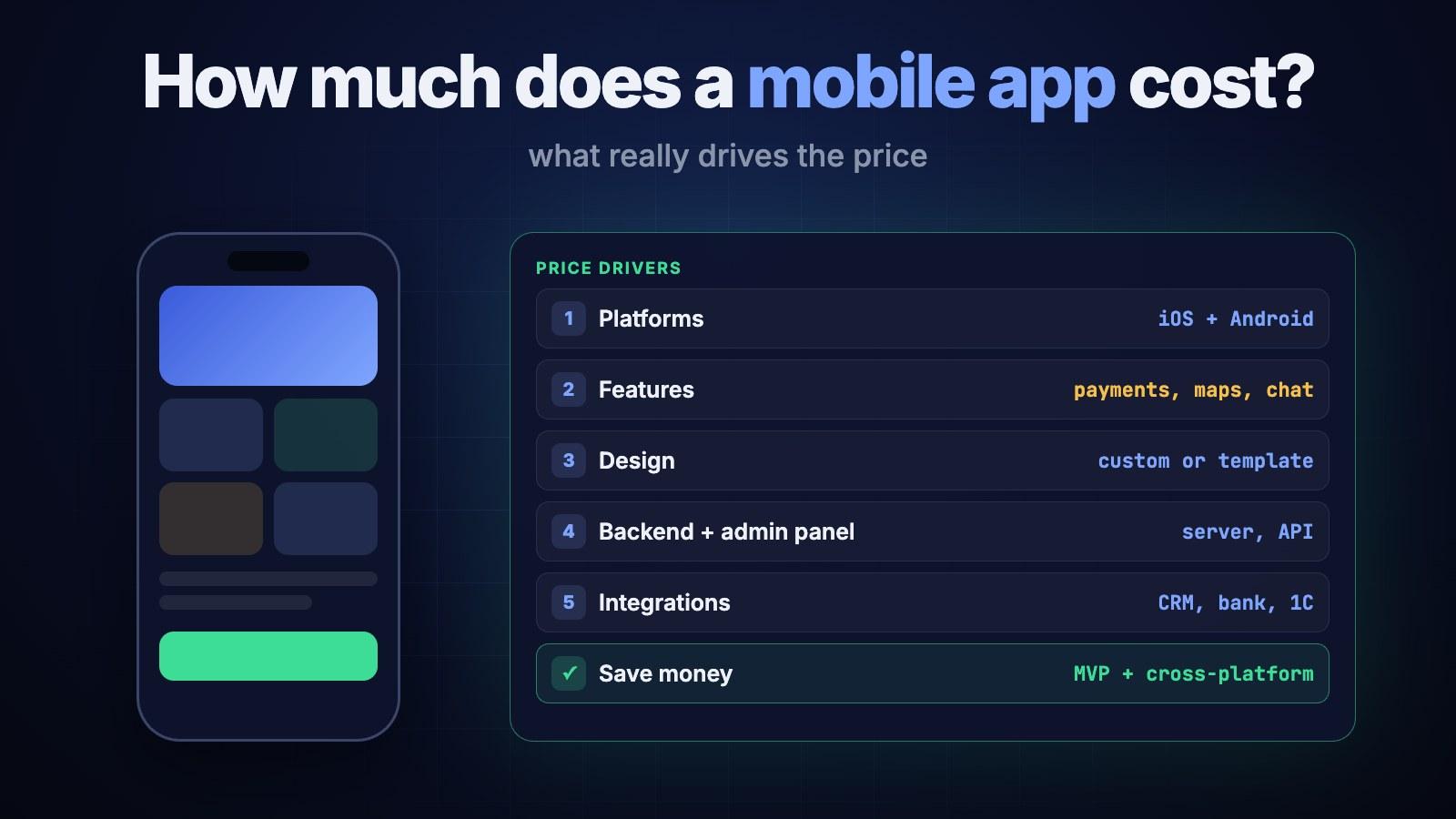
The honest answer to "How much does a mobile app cost?" is: it depends on the app. The gap between a simple booking app and a delivery service is as wide as the gap between a landing page and an online store. But the factors that drive the price are always the same. Once you know them, comparing quotes and planning a budget gets much easier.
1. One platform or two
Your customers use both iPhone and Android, so you usually need the app on both platforms. There are two ways to get there:
- Cross-platform (React Native, Flutter): one codebase runs on both iOS and Android. Faster to build, cheaper to maintain. Enough for most business apps.
- Native (Swift, Kotlin): separate code for each platform. Worth it for complex graphics, animations or deep device features, but it effectively means two teams.
In most cases, cross-platform development is the single biggest budget saver.
2. Features: the bulk of the price
Every screen and every feature is hours of work. The features that add the most cost are:
- sign-up and user accounts;
- online payments and subscriptions;
- maps, geolocation and courier tracking;
- chat and push notifications;
- offline mode and sync;
- device features such as the camera, QR codes and Bluetooth.
The simplest way to control the budget is to split the feature list into "must have" and "can add later".
3. Design
A simple interface built from ready-made components costs less. A custom design for your brand, with illustrations and animations, costs more but sets the app apart from competitors. Good design also keeps users from deleting the app, so cutting corners here is usually a mistake.
4. Backend and admin panel
The "invisible" part of an app is often forgotten. Orders, products, users and notifications have to be stored and managed somewhere. That takes a server, an API and an admin panel, which can be as much work as the app itself. If you already have a website or a CRM, connecting the app to it may be cheaper.
5. Integrations
Bank payments, accounting software, CRM, delivery services, SMS and email. Every integration means separate development and testing. Services with a ready-made API are quick to connect; legacy systems take longer.
6. Testing and app store publishing
The app has to be tested on different phones, screen sizes and OS versions. Then it is published on the App Store and Google Play. That requires developer accounts: Apple charges $99 a year, Google Play a one-time $25. Apple's review sometimes asks for changes, so build that into the timeline too.
7. After launch: support
Costs don't end on release day. New versions of iOS and Android come out every year, and the app needs updating for them. On top of that, budget for the server, bug fixes and new features. The app stores take a commission on digital goods sold inside the app, so factor that in if you are planning a subscription.
How to save money
- Start with an MVP. Ship a first version with only the core features and grow it based on user feedback.
- Go cross-platform unless there is a serious reason to go native.
- Reuse what you have. The backend of your website or CRM can often serve the app too.
- Invest in the prototype. Fixing a mistake in a clickable prototype is many times cheaper than fixing it in finished code.
Timelines
A simple MVP can be built in a few weeks; a full app with payments, maps and an admin panel usually takes a few months. The exact timeline depends on the feature list, so it is estimated together with the price.
The bottom line
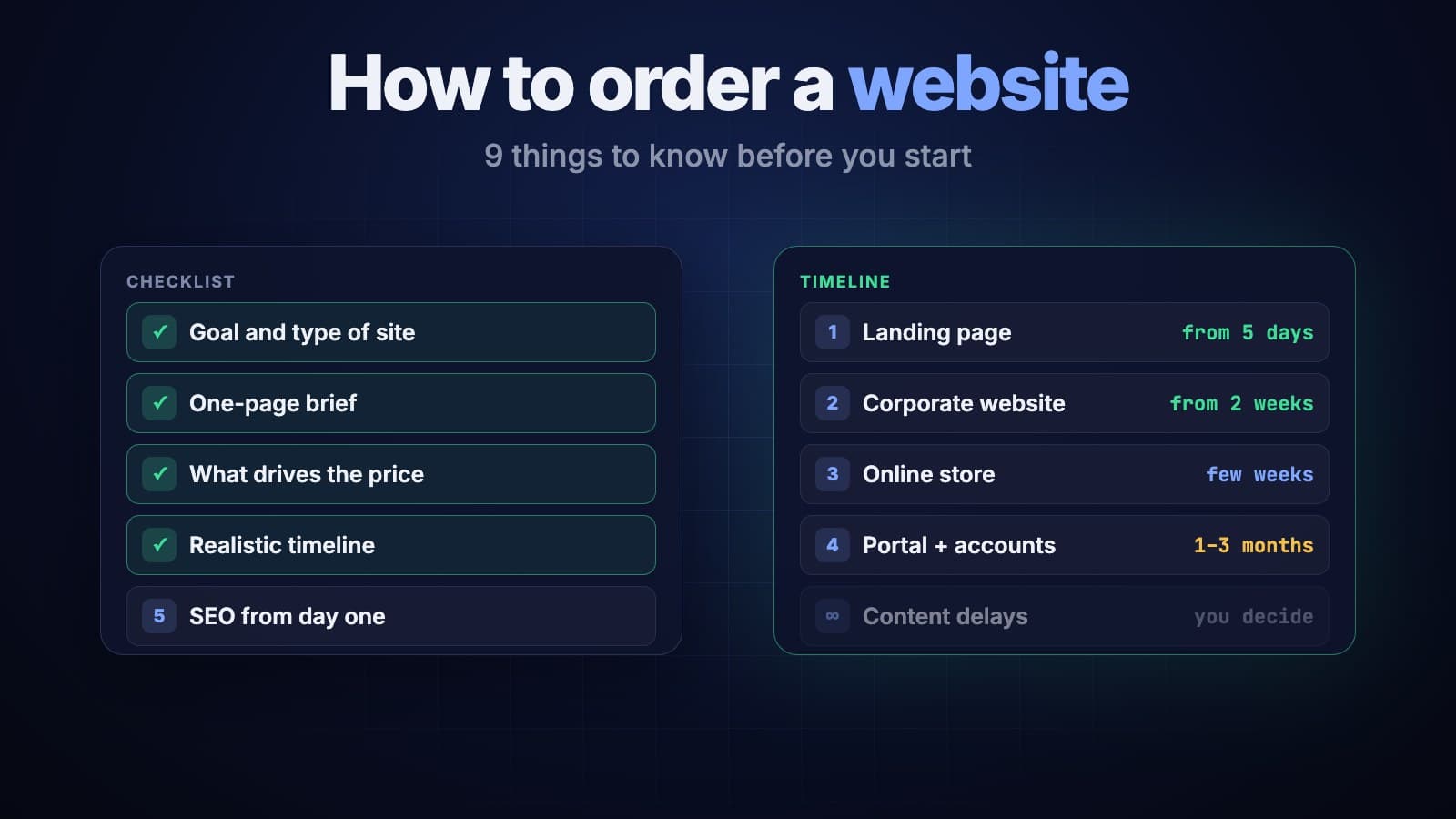
The cost of a mobile app is made up of platforms, features, design, backend, integrations and support. The smartest path is a clear goal, a small MVP and cross-platform development. If you need a website before the app, read our guide to ordering a website.
We provide mobile app development for iOS and Android, including the backend, admin panel and app store publishing. If the app needs to connect to your business systems, we also work with CRM and ERP. Tell us your idea and we'll estimate the price and timeline.